 Skip to content
When I explain Brazilian music genres, I start with geography and technique. Samba in Rio, samba de roda in Bahia and maracatu in Pernambuco do not come from one national formula. Each form developed through particular communities, instruments and ways of organizing time.
I was trained as a musicologist in Cuba, so I tend to listen for connections across the Atlantic and the Caribbean. Brazil makes those connections audible, but it also resists easy comparison. Portuguese language, Indigenous histories and several African lineages shaped local practices in different ways. Urban migration, radio and recording studios changed them again.
This guide follows three places: Rio de Janeiro, Salvador da Bahia and Recife with nearby Olinda. I will name the instruments, describe the timing and point to the physical settings where the music works. That is more useful than treating every Brazilian style as Carnival music.
I do not ask which genre represents Brazil. I ask who plays it, where they rehearse and how the parts fit together.
A practical map of Brazilian music genres
- Rio de Janeiro: choro, urban samba, partido-alto and bossa nova.
- Salvador and the Recôncavo: samba de roda, Candomblé music, blocos afro, samba-reggae and Tropicália.
- Recife and Olinda: frevo, maracatu-nação, forró, baião and manguebeat.
These labels help us begin. They are not sealed boxes. Musicians move, recordings circulate and one city can support many practices at once. Still, place matters. A neighborhood samba rehearsal asks something different from the players and listeners than a seated bossa nova set.
Rio de Janeiro: choro, samba and bossa nova
Choro: counterpoint in a social circle
Choro developed in 19th-century Rio as musicians worked with European dance forms and local ways of accenting the beat. A standard group may include flute or bandolim, cavaquinho, six-string guitar, seven-string guitar and pandeiro. The instrumentation can change, but the conversation among parts remains central.
I listen first to the seven-string guitar. Its lower strings let the player create moving bass lines called baixarias. Those lines answer the melody and connect one harmony to the next. The cavaquinho marks chords with a dry attack. A pandeiro player divides the measure among thumb tones, fingertip strokes, slaps and jingles. The instrument can state the pulse while placing accents around it.
The melodic player has freedom, but not unlimited space. Ornamentation and fast runs need to land against the harmonic turns. In a roda de choro, musicians sit facing one another and use eye contact to manage repeats, solos and endings. That physical arrangement explains the music better than a stage photo does. The Instituto Moreira Salles offers useful historical context for choro and Brazilian popular music.
Samba: several percussion parts, one coordinated system
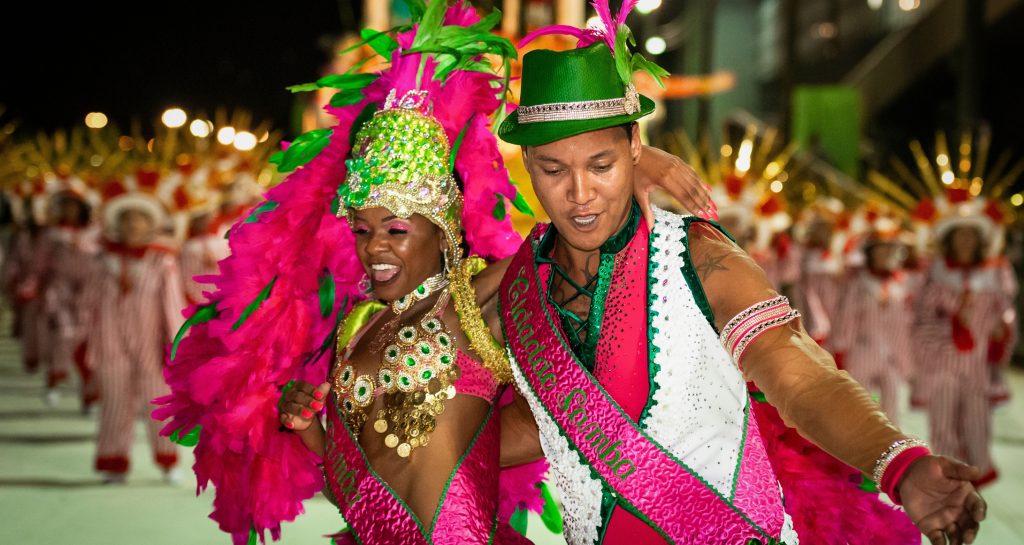
Samba is not one beat. In a Rio samba school, the percussion section may include first, second and third surdos. Each drum has a distinct placement in the measure. The lower surdos establish the main alternation. A third surdo can answer with more mobile phrases. Caixa players maintain a continuous mesh of strokes, while tamborins cut through with high attacks.
Listen to a tamborim pattern called carreteiro. Rapid notes are grouped so that accents push against the main pulse. The agogô adds pitched bell figures. The cuíca produces bent tones through friction on a stick inside the drumhead. Repiniques can cue sections and answer vocal calls. None of these instruments merely doubles another.
At a neighborhood rehearsal, the physical scale matters. Dozens of players have to coordinate without flattening the internal movement. A director uses hand signals and repinique calls to control entrances, breaks and changes in density. In a smaller roda de samba, cavaquinho and guitar carry harmony while pandeiro, surdo and hand percussion support singers seated around a table.
Partido-alto gives special attention to improvised verses and response. A lead singer proposes a line. The group returns a refrain. Timing matters because the verbal phrase can begin before the expected downbeat or continue across the bar. Our articles on Afro-Brazilian history in Rio and samba’s cultural diversity place these practices inside a wider social history.
Bossa nova: quiet singing and displaced guitar attacks
Bossa nova changed the scale of samba performance. João Gilberto could sing at conversational volume because the microphone carried small details. His delivery often sits close to speech. He avoids theatrical projection and places syllables with great control, sometimes slightly ahead of or behind the guitar.
The guitar part is equally precise. The thumb marks bass notes, while the fingers place upper chords in syncopated positions. Those chord attacks suggest percussion parts without copying a full samba ensemble. The apparent calm requires exact coordination. If the upper chord arrives a fraction too early or too late, the whole time feel changes.
Antonio Carlos Jobim brought extended harmony and careful orchestration into this language. Major sevenths, ninths and chromatic bass movement appear often, but harmony alone does not define the style. The relation between voice, guitar and silence does. Our Bossa Nova and Copacabana program treats that listening practice as part of Rio’s musical history.
Salvador da Bahia: samba de roda, sacred practice and blocos afro
Samba de roda: song, clapping and movement in a circle
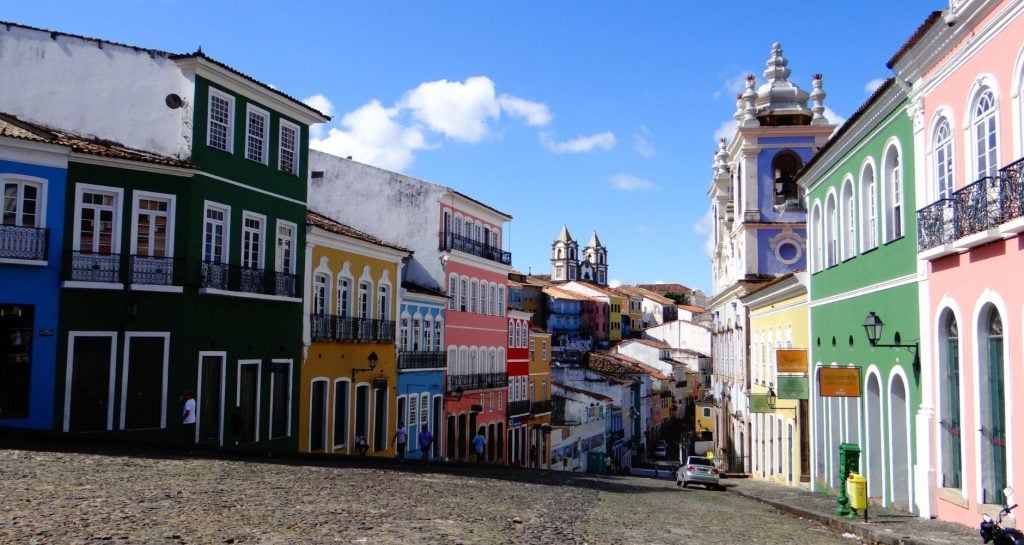
Samba de roda comes from the Recôncavo Baiano and has deep ties to Afro-Brazilian community life. Participants form a circle. Singing moves through call and response. Handclaps establish a repeating frame, while pandeiro and other percussion add subdivisions. In some settings, the small viola machete supplies short harmonic figures.
One dancer enters the center at a time. The umbigada can signal a change of dancer. Music and movement are not separate departments here. The footwork shows how accents are felt, and the circle controls attention. UNESCO recognizes the samba de roda of the Recôncavo of Bahia as intangible cultural heritage.
Candomblé: musical knowledge inside sacred practice
Candomblé ceremonies use music as part of religious action. The three main atabaques are often named rum, rumpi and lê. The rum has the most space to vary and cue movement. Rumpi and lê maintain supporting patterns. A metal bell called gã or agogô can state a reference pattern that helps organize the ensemble.
The songs, drum parts and dances correspond to specific liturgical knowledge. They are not interchangeable examples of “African influence.” Nation, house and ceremonial purpose matter. Visitors should follow the rules of the community. Photography or recording may be restricted, and musical explanation does not grant access to sacred material.
Blocos afro and samba-reggae: public percussion with political purpose
Groups such as Ilê Aiyê and Olodum changed Salvador’s Carnival through music, visual identity and Black political organization. Their percussion sections use surdos in several registers, along with repiniques and caixas. The lower drums establish weight. Higher parts answer with cuts and offbeat figures.
Samba-reggae places reggae-derived offbeat logic inside a large Bahian percussion ensemble. The result depends on the spacing among drum parts. If every player fills the same subdivision, the structure collapses. Good arranging assigns each register a job and leaves openings for vocal lines and dance.
Read our field guide to music in Bahia and our article on African continuities in Brazilian cities for more social context.
Recife and Olinda: frevo, maracatu and forró
Frevo: fast brass writing built for the street
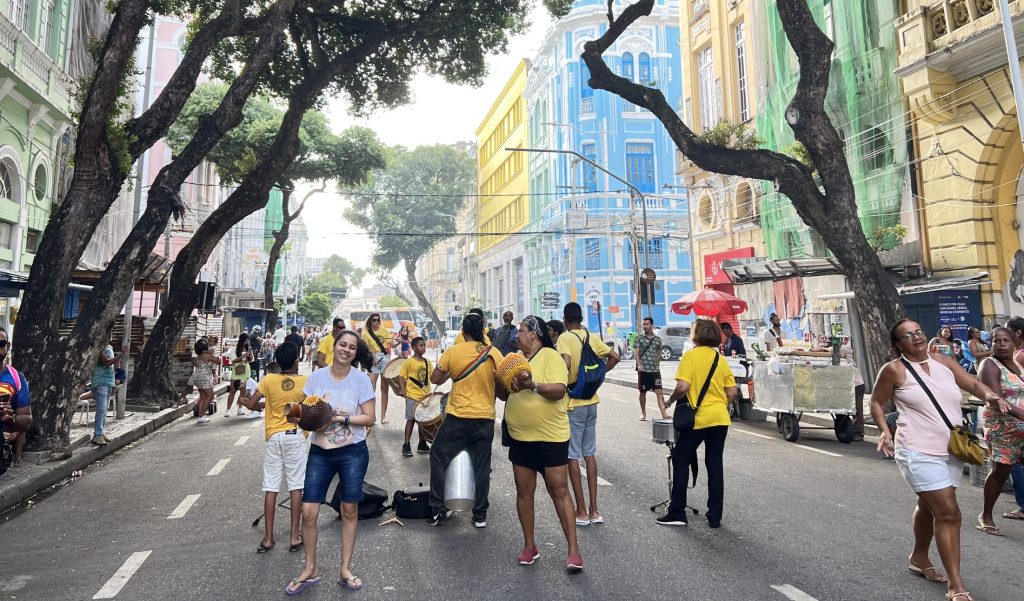
Frevo is associated with Carnival in Recife and Olinda. Brass and reed players carry rapid melodies in duple meter. Trumpets, trombones and saxophones often work over tuba, snare drum and cymbals. The lines use repeated notes, arpeggios and sudden register changes. Articulation must stay clear even while the group moves outdoors.
The dance practice called passo answers the music with low positions, kicks and quick directional changes. The small umbrella helps balance and has become part of the visual vocabulary. UNESCO lists frevo as intangible cultural heritage.
Maracatu-nação: the weight and turn of the baque
Maracatu-nação groups carry histories connected to Black communities, religious houses and Carnival procession. The alfaia supplies a deep drum sound. Players use sticks and coordinate interlocking parts across a large section. The gonguê cuts through with a metal bell pattern. Caixa and tarol add snare strokes, while mineiro or abê provides a continuous layer of smaller subdivisions.
In baque virado, accents turn around the reference pulse and create forward pull. A lead voice gives calls. The chorus responds. Drum cues control entries and changes. The physical force of an alfaia section is obvious, but precision is the real measure. Straps, stick height and ensemble spacing affect the sound.
IPHAN has documented the cultural importance of maracatu-nação. A respectful visit should name the nation, its community and its leaders rather than presenting the drums as anonymous Carnival spectacle.
Forró and baião: accordion, zabumba and triangle
A classic forró trio uses accordion, zabumba and triangle. The zabumba player strikes one head with a mallet for the low tone and uses a thinner stick on the opposite head for a sharper response. The triangle maintains a fine stream of subdivisions and opens selected strokes by releasing the damping hand. Accordion bass buttons mark the foundation while the right hand carries melody or chord figures.
Luiz Gonzaga helped establish baião and forró in Brazil’s national media during the 20th century. His work carried northeastern repertory into radio and recording markets. Later, Recife’s manguebeat scene placed local percussion beside electric bass, guitar, sampling and hip-hop production. Chico Science and Nação Zumbi made that approach widely audible without treating regional practice as a museum object.
Our musician’s field notes from Recife and Rio give a closer account of rehearsal rooms and live performance.
MPB and Tropicália: categories shaped by records and debate
Música Popular Brasileira, usually shortened to MPB, is not a single technical style. The term became associated with post-bossa songwriting, festival culture and the recording industry in the 1960s. It can include regional references, orchestral writing, electric instruments and politically coded lyrics.
Tropicália artists questioned ideas of cultural purity. Caetano Veloso, Gilberto Gil, Gal Costa, Tom Zé and their collaborators worked with Brazilian song forms and electric rock. Studio arrangement became part of the argument. Distorted guitar, brass writing and tape techniques could sit beside berimbau or regional percussion without pretending that the sources were identical.
I listen for the arranger’s decisions. Which instrument carries the bass? Does percussion state a local pattern or comment on it? Is the singer using speech-like placement, open projection or choral response? MPB becomes clearer when we follow those choices instead of using the label as a catch-all.
A starter listening list by place
- Rio de Janeiro: hear Pixinguinha for choro counterpoint, Cartola for samba composition, João Gilberto for guitar and vocal placement, and Elza Soares for phrasing that changes across decades.
- Salvador and Bahia: compare Dorival Caymmi’s song writing with Gilberto Gil’s guitar work. Then hear Ilê Aiyê and Olodum as percussion organizations with distinct histories.
- Pernambuco: listen to Luiz Gonzaga for baião, Capiba for frevo and Chico Science & Nação Zumbi for the electric language of manguebeat. Add recordings by named maracatu nations rather than relying only on commercial compilations.
How I listen in person
- I identify the timekeeper. It may be a bell, a handclap pattern, a bass drum or a guitar thumb.
- I separate the registers. Low surdos and alfaias do not perform the same job as tamborins, caixas or gonguês.
- I watch the cues. Hand signals, calls and eye contact show how the group manages form.
- I listen to vocal placement. A partido-alto call, a Candomblé song and João Gilberto’s close-miked delivery require different kinds of attention.
- I ask about the setting. A roda, religious house, samba school rehearsal and concert stage follow different rules.
Choose the city by the musical question
Choose Rio if you want to compare choro counterpoint, samba percussion and bossa nova guitar technique. Choose Salvador if your main question concerns Afro-Brazilian continuity, public percussion or song in the Recôncavo. Choose Recife and Olinda for frevo brass writing, maracatu nations and northeastern dance music.
Our Brazil music and cultural tour connects those questions with working musicians and local specialists. You can also see our current Brazil music programs and compare the cities by repertoire.
To hear these traditions where they live, explore our 10-day Rio, Salvador and Recife itinerary and travel impressions from Rio Carnival.
If your listening interests call for more time in one region, our private Brazil music journey can start with those questions and develop a route around them.